
The Middle East, Social Media, and Conversations with Twesigye Jackson Kaguri
We live in a time where people like Twesigye Jackson Kaguri, Maria Ressa, and those brave women in Israel and Palestine are doing the quiet, persistent work of building peace, truth, and hope.
There’s a particular gravity to the conversations unfolding about the Middle East, especially in the context of the war between Israel and Gaza, a conflict that has resurfaced with devastating intensity. At CGI, these discussions were not just political— they were deeply personal for many in the room, particularly those who have dedicated their lives to peace and reconciliation in the region. As I absorbed the dialogue, it became evident that the weight of these ongoing tensions transcends borders and touches each of us, even if indirectly.
I couldn’t help but think about the extraordinary resilience of women in these war-torn regions. Especially those who keep working toward peace, even when the odds seem impossible. Inspired by a Nobel Peace laureate, two mothers—one Israeli and one Palestinian—have built a coalition of thousands. They are united by a single, shared identity: motherhood.
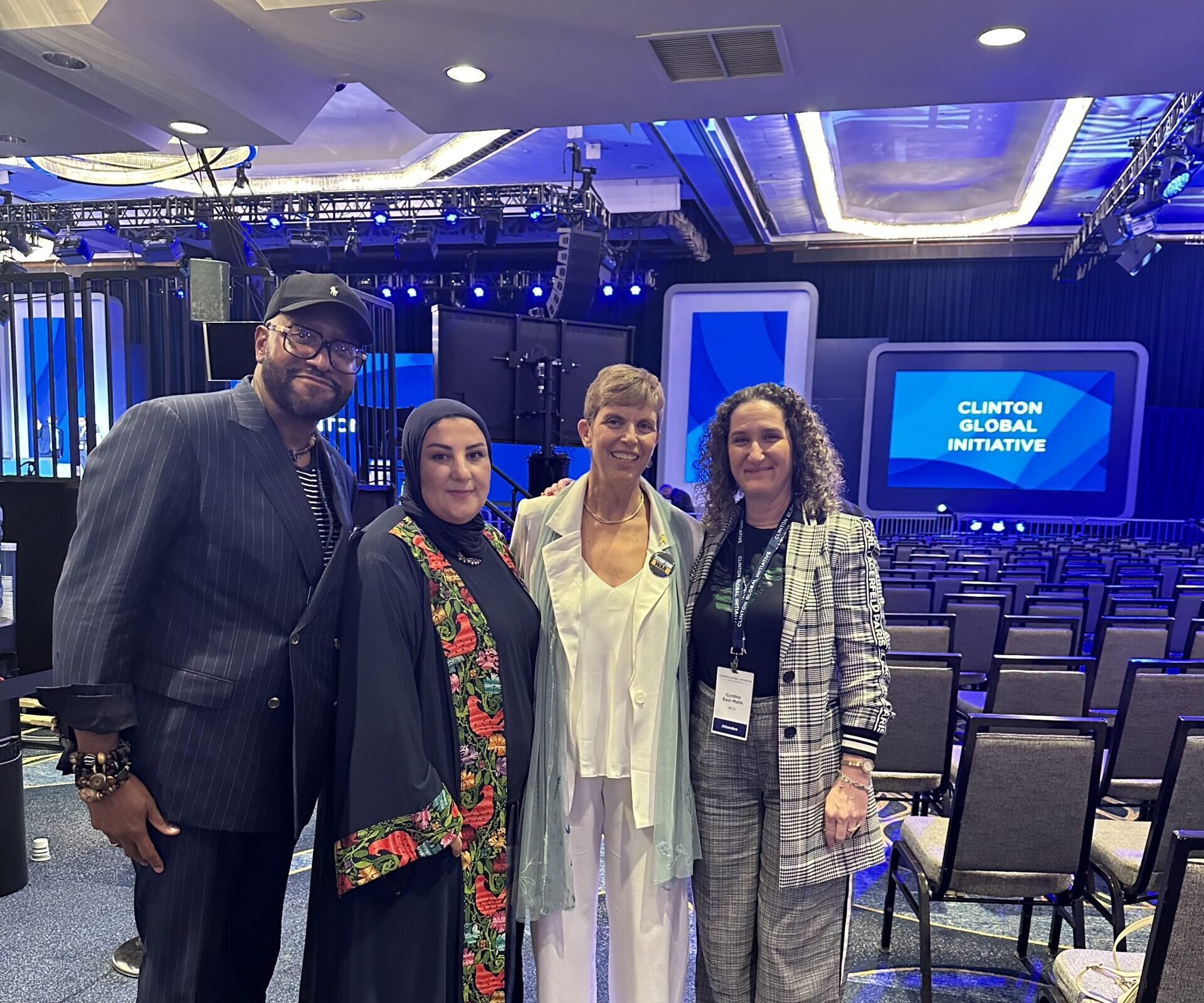
Yael Admi, co-founder of the Israeli movement Women Wage Peace, and Reem Hajajreh, founder of Women of the Sun, are not just fighting for their own children. They are fighting for the hope that their children might one day live in a world where conflict no longer shapes their lives. Their work rises above politics. It speaks to the heart of what it means to choose love over hatred. Humanity over violence.
These conversations about the Middle East intersected with a different, though equally urgent, theme: the impact of social media on our children. Prince Harry’s reflections on the deadly consequences of misinformation and online manipulation were a stark reminder that the battlefield is not always physical. Social media, with its unchecked spread of disinformation and toxic narratives, has become a new front where young minds are the casualties.
Harry spoke passionately about the staggering number of children, ages 6 to 19, whose lives have been either lost or irrevocably altered because of social media’s far-reaching influence. He didn’t mince words when describing the emotional toll this digital landscape takes on the most vulnerable among us. “Children should not be fighting a war they never signed up for,” he said, his voice tinged with both frustration and sorrow. The connection between misinformation, emotional manipulation, and real-world consequences became even clearer as he referenced the mental health crises and rising suicide rates that can be traced back to online platforms designed to exploit attention rather than foster truth.
Maria Ressa’s warning that lies travel six times faster than the truth felt especially pertinent here. We live in a world where information is weaponized, and it often falls to our children to bear the brunt of that violence. It made me wonder: What does it say about our society that we are willing to sacrifice our youth on the altar of profit-driven algorithms?
Against this backdrop, I had the privilege of spending time with Twesigye Jackson Kaguri, a man whose work is the very embodiment of choosing life in the face of adversity. Twesigye, the founder of the Nyaka AIDS Orphans Project, shared his story with me in a way that was both humbling and deeply inspiring. He began his journey in a small Ugandan village, and through his unwavering commitment, he has transformed the lives of thousands, offering not just education but hope to a generation impacted by the HIV/AIDS epidemic.
Our meeting wasn’t planned—it was one of those serendipitous moments that seem to happen when you are open to receiving them. We were seated near each other at a session, and though our initial interaction was brief, it was enough to plant the seed for a deeper connection. Later, during a networking event, Twesigye noticed the beads I wore on my wrist, a simple accessory that suddenly became a bridge between us. He recognized them instantly as coming from Uganda, from his home. It was a small thing, but it unlocked a larger conversation about our shared values, our work, and the ways in which personal and collective histories can intertwine.
Twesigye, in a gesture of generosity that left me both honored and moved, took off a brass bracelet he wore, one that had the shape of the African continent etched into it, and offered it to me. “Put this on,” he said, with a smile that spoke of shared understanding. In return, I gave him one of my favorite bracelets, a symbol of our newfound bond. It was an exchange that went beyond material objects— it was a recognition of our shared humanity, our commitment to using whatever strength we have to lift others up.
As we talked, I couldn’t help but reflect on the stark contrast between the digital world Prince Harry warned us about and the real, tangible work that people like Twesigye are doing on the ground. Where social media seeks to manipulate, exploit, and divide, Twesigye’s work is rooted in connection, in empowerment, in the belief that one person’s strength can indeed change another’s life. He spoke about the grandmothers in his community who had become the bedrock of survival for countless orphans. His organization not only educates children but also empowers these women with micro-loans and training, giving them the tools to transform their own lives and the lives of those around them.
In a world so often focused on conflict—whether in the Middle East or on the digital battlefield of social media—Twesigye’s story was a reminder that there are still places where love, kindness, and perseverance prevail. It’s easy to be consumed by the enormity of the challenges we face, but there are people like Twesigye who, through their actions, remind us that solutions don’t always come from the grand stage. Sometimes they come from one bracelet exchanged for another, one life touched by the strength of another.
Leaving that conversation, I felt a renewed sense of purpose. Yes, we live in a time where disinformation spreads like wildfire, where democracy is fragile, and where conflict seems never-ending. But we also live in a time where people like Twesigye Jackson Kaguri, Maria Ressa, and those brave women in Israel and Palestine are doing the quiet, persistent work of building peace, truth, and hope. And that, more than anything, is what gives me hope for our future.
These are stories carried home from the Clinton Global Initiative Annual Meeting.
This is Part III of a four-part reflection on what moved me—between the keynotes and the quiet.
Follow the rest of the journey here: