Nyaka to the future: How a Young Woman in Uganda is Using AI to Transform Rural Communities.
For most people, technology is about circuits, code, and connectivity. But for Deliverence Tukamushaba, a proud alumna of Nyaka, supported through tuition sponsorship from Beautiful World Canada, it started with something far more personal: a question.
“Does where I was born determine how far I can go?”
That question followed her from her rural Ugandan village to the lecture halls of Nkumba University, where she studied Information Systems and Technology. And it was there, during her first successful digitalization project, watching a slow, paper-based process transform into something instant and global, that she found her answer.
No. Origin is not a barrier. It is a competitive advantage.
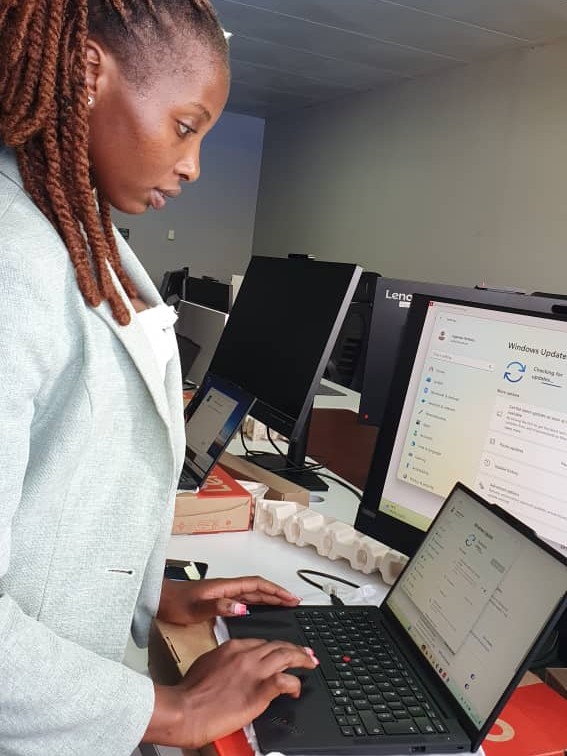
Today, Deliverence works in the high-stakes world of IT operations in the aviation sector. But her heart remains rooted in the soil of rural Uganda, and in a bold vision, made possible because Beautiful World Canada invested in her education through Nyaka, to bridge the education gap using artificial intelligence.
From sponsored student to community problem-solver
Without the financial support of Beautiful World Canada, Deliverence’s story might have ended before it began. Their sponsorship of her tuition at Nkumba University didn’t just pay for lectures and exams, it bought a rural girl the most precious thing: time to dream, time to learn, and time to return as a solution.
“The defining moment,” she recalls, “was realizing that my background in a rural setting gave me a unique user perspective that many urban developers lacked. My origin wasn’t a barrier. It was my competitive advantage.”
That advantage is now being deployed not for personal gain, but as a direct return on the investment that Beautiful World Canada and Nyaka made in her. She is no longer a sponsored student. She is a problem-solver.
The problem no textbook could solve
In many rural classrooms, a single textbook is shared by dozens of students. A teacher, however gifted, cannot give fifty different children fifty different explanations. The curriculum moves at one pace, and too many are left behind.
“The specific problem is the stagnant curriculum and the lack of personalized feedback,” Deliverence explains. “AI can step in as a 24/7 personalized tutor, adapting its language and examples to a student’s local context, translating complex global concepts into the relatable language of their own village.”
She imagines a student learning physics not through abstract diagrams, but through the mechanics of a water pump she uses every day. That is not just education. That is liberation, and it is being designed by a woman whose own education was once sponsored from thousands of miles away.
Beautiful World Canada paid for her tuition. Now she is building a tool that could pay forward that gift to an entire generation.
Building with, not for
The 2026 International Girls in ICT theme is clear: Girls shaping the digital future. Not watching it. Not waiting for it. Shaping it.
Deliverence takes this personally.
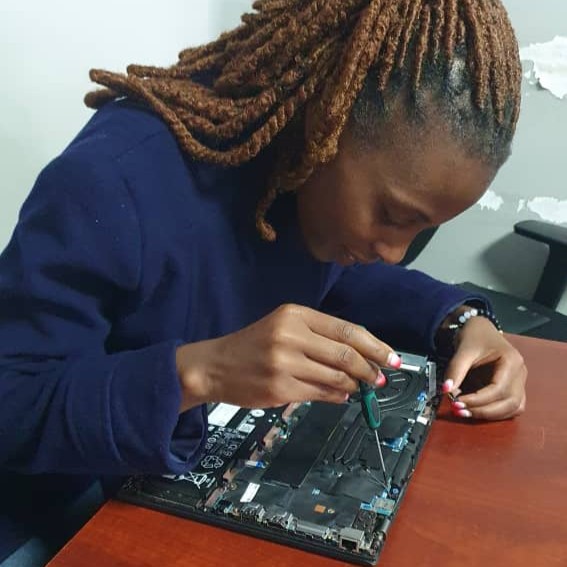
“I believe in building with, not for,” she says. In her recent proposals for the Nyaka Digital Excellence project, she introduced the Tech-Squad initiative, a program that identifies young girls and trains them as Junior IT Leads who audit and troubleshoot the very systems they use.
“By putting the keys to the lab in their hands, we ensure that the digital future of the community is designed by those who actually live its challenges daily.”
This is the ripple effect that Beautiful World Canada and Nyaka exist to create: one sponsored girl becomes a hundred problem-solvers.
The moment she almost quit
The journey was never easy. Transitioning from university to IT operations in aviation brought crushing pressure and glaring resource gaps. There were days Deliverence wanted to walk away.
But then she remembered: As a Nyaka Alumnus, sponsored by the generosity of Beautiful World Canada, I wasn’t just working for myself. I was representing a whole community of girls who needed to see that this path is possible.
That awareness, that her success paves the way for others, became her anchor.
“Resilience in ICT isn’t just about fixing a bug in code,” she says. “It’s the Nyaka-first mindset. It’s honoring the investment that was made in me by becoming someone who invests in others.”
Breaking the urban myth
There is a dangerous misconception in urban tech hubs: that rural communities are not “ready” for advanced technology like AI.
Deliverence disagrees, strongly.
“Rural students are often more innovative because they are used to solving problems with limited resources. They don’t need simpler tech. They need smarter tech that works within their infrastructure constraints, like offline-first AI models.”
She points out that readiness is not about access to the latest devices. It is about curiosity, resourcefulness, and the hunger to solve real problems. The same hunger that Beautiful World Canada saw in her when they first chose to sponsor her tuition.
Five years from now: from consumers to creators
When asked what she wants to see by 2031, Deliverence’s answer is vivid and unshakable:
“I want to see girls from rural schools deploying their own AI models to solve local agricultural, education, or health challenges. When girls audit and deploy AI themselves, we eliminate the bias that often forgets the rural girl.”
She pauses, then adds with quiet conviction:
“I want the next big African tech innovation to come from a girl who started in a Nyaka classroom, and whose tuition was once sponsored by someone on the other side of the world who believed in her.”
That is the true return on investment for Beautiful World Canada: not a graduate, but a solution-builder.
Her message to a 14-year-old dreamer
And what of that young girl today, sitting in a remote village with no computer at home and limited internet, who whispers, “I want to do what you do”?
Deliverence’s answer is immediate and tender:
“Start with logic and curiosity. You don’t need a computer to learn how to think like a programmer. Look at the manual processes in your home or village and imagine how they could be made faster or better. That is systems analysis. Seek out mentorship. Use every moment of access you have, even if it’s just a few hours a week at a school lab, to explore with purpose. Your mind is your primary tool. The computer is just an accessory.”
She adds, softly:
“And know that somewhere, people like those at Beautiful World Canada and Nyaka are looking for girls exactly like you to sponsor. Be ready for them by already thinking like a problem-solver.”
A future shaped by Nyaka girls, powered by Beautiful World Canada
Deliverence Tukamushaba is not waiting for permission to build the future. She is already shaping it, one line of logic, one mentored girl, one offline-first AI model at a time. On this International Girls in ICT Day 2026, her story is more than inspiring. It is proof that sponsorship doesn’t just change one life. It creates a problem-solver who changes a hundred more.
Beautiful World Canada paid for her tuition. Nyaka believed in her journey. And now Deliverence is building an AI model to ensure that no rural child is left behind. That is the power of a girl who was given a chance and decided to become the solution her community was waiting for.